

|
The word "festival"("matsuri" in Japanese) usually remind us stalls in thestreet, portable shrines("mikoshi" in Japanese) and so on. Would you like to know what the word "festival" means originally? |
|
The archaic Japanese word "matsurafu"written in Manyoshu,
the oldest anthology in Japan,is equivalent for the word "festival".
The word "matsurafu" means inviting our deities,making offerings for them
and praying them for keeping evels and diseases away from us and bringing us happiness.
One Japanese festival usually has three stages.
They are the grand festival,the ceremony of the festival and the "shinkosai" festival
in which our deities parade riding on the portable shrines,"mikoshi".
We Japanese call all of them in one word "matsuri".
One of the essential articles for the Japanese festival is the portable shrine,"mikoshi".
Originally "mikoshi" is the vehicle for our deities to parade.
And,each of the deities has own "mikoshi",for example in the "Sanja"(means three shrines) Festival
three "mikoshis" are used for the first shrine,the second shrine and the third shrine.
By the way,these three "mikoshis" survived through many fires,for example,
the fire in the Great Kanto Earthquake,but at last they were burned in the fire of the war damage.
Fortunately the plans of the three "mikoshis" escaped the war damage
and the "mikoshis" were restored after the war and are still now used.
Those "mikoshis" are now usually kept in the temporary house made
by the steeplejacks by using logs and bamboos in the traditional way.
This traditional way of building was taught from generation to generation
and still now the steeplejacks are taught about it from more experienced men naturally.
The festivals consist of three factors,which are the sponsors,the participants and the viewers.
And,of course,when these three factors work as one,the festival becomes the wonderful event.
In Asakusa very popular streets like the Metro Street and the Orange Street play the good supporting roles
to make up the festivals as the wonderful events.
And,many large paper lanterns hung on poles ("takaharichochin" in Japanese) decorated around the Sensoji Temple
play the same role.
Many people feel the beautiful scene of the lanterns lighted at night like a dream.
The Sanja Festival in Asakusa is such a delightful event and is crowded with about 3 million "galleries" every year.
Applause and cheering from both the local people in Asakusa
and many "galleries" from other areas arouse the excitement in the Sanja Festival every time.
We think the excitement in the Sanja Festival has great importance when we compare
with many other areas in Tokyo where people are reluctant to live and their catch phrase "My hometown Tokyo" sounds ironically.
Jan・Feb・Mar・Apr・May・Jun
- Events in Asakusa-
Jul・Aug・Sep・Oct・Nov・Dec
Note: The schedule may change for items that are "planned".
| January, 2024("Mutsuki" in old Japanese) | ||
| 1st | Paying The First Visit To The Shrine Of The Year | |
| Pilgrimage to the shrines / temples on New Year's Day. | ||
| 7th | The Festival For The Japanese Radish | |
| Held in Matsuchiyamashoten People make offerings various kinds of food to Matsuchiyamashoten,the guardian deity for Buddha. People pray for the safety of their families and for prosperity of their business in this Buddist service. After that the attendants boil Japanese radishes and eat them putting vinegared miso on them. |
||
| 8th | Tondo Yaki | |
| This ceremony is held in the Torigoe Shrine. People burn many remains of the New Year's goods. It is traditionally said that we can spend the year in good health by exposing ourselves to this fire. 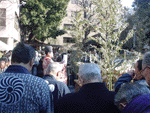 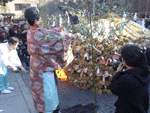 It was done modesty and the fire was Powerful full mark. TV shooting was taking place. |
||
| February, 2024(Kisaragi) | ||
| 3th | Coming Spring(Setsubune) | 
|
The shout of "Out with the devil!In with good fortune!"("Fuku wa uchi!Oni wa soto!" in Japanese)prevailed as the custom in the Muromachi era.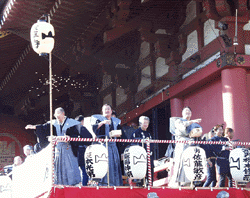 |
||
| 3th | The Dance For Happiness And Long Life |
|
| Held in the Sensoji Temple. This dance was shown for the first time in the 39th year of Showa when the Hozomon Gate was completed. Some people say this dance was adopted for praising happiness and prosperity of Kannon refering to the historical event of the Seven Deities of Good Luck. 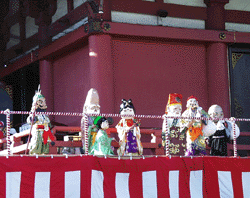 |
||
| 8th | The Memorial Service For Needles |
|
| People hold a memorial service for needles by sticking needles on "tofu" on a small wooden stand("sanpo" in Japanese) in the Awashimado Hall in the Sensoji Temple. Some people say this ceremony was introduced from China. |
||
| - | The Hina Dolls Fair | |
| This event is canceled. Hina dolls are sold. It was started in the Edo era and lost popularity at one time. In recent years it has got back prosperity. 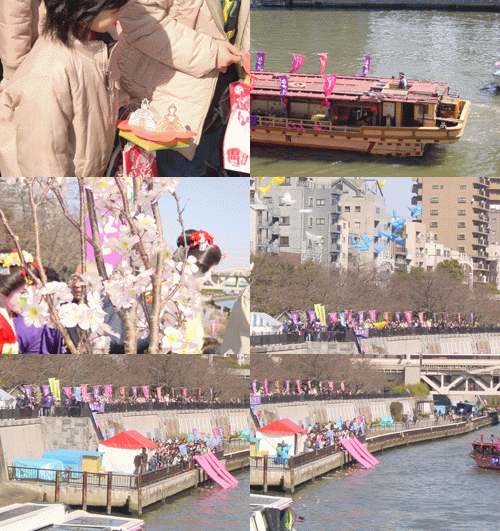 Wind was strong and it was becoming "Nagashi Hinadolls" "Hinadolls flying", but the balloons of the dove flew, and the kimono sleeper came, it was done gorgeously. |
||
| Late February | Asakusa・Sumida Park Plum Festival | |
| Held in Sumida Park | ||
| March, 2024(Yayoi) | ||
| 3th | Tokyo Marathon 2024 | |
| Runner runs in front of Asakusa Kaminarimon. In front of Tokyo Metropolitan Government Office 9:05 Start Marathon: Tokyo Metropolitan Government Office~Iidabashi~Kanda~Nihonbashi~Asakusa Kaminarimon~Ryogoku~Monzennakacyo~Ginza~Tkanawa~Hibiya~In front of Tokyo Starion・Gyoko dori 10.7km:Tokyo Metropolitan Government Office~Iidabashi~Kanda~Nihonbashi |
||
| 18th | The Anniversary Meeting Of The Appearance Of Asakusa Kannon,The Dance Of Gold Dragon | |
| This event is connected with the tradition that the gold figure of Sei Kannon was pulled up from the Miyato River(the present Sumida River) on March 18 in 628. Held in the Sensoji Temple. |
||
| 17th-18th | Do-age, Do-sage |
|
| 18th | Visiting and exiting of portable shrines |
|
| Jigen-e is held in early spring in middle of March. The highlight of this festival is do-age and do-sage, the visiting and exiting ceremony of portable shrines of Asakusa Shrine. Three deities, Ichinomiya (Hajinoma Nakachi), Ninomiya (Hinokuma Hamanari), and Sannomiya (Hinokuma Takenari), who found the Kannon statue in the sea, pay visit to Kannon once a year, in Asakusa Temple where they had enshrined to worship the God of Mercy.
In present days, ceremony is carried out following the traditional rites on Saturday and Sunday closest to March 18th, and it will be on the 13th and 14th in 2004. In the late afternoon on the 13th, the three portable shrines with principal idols on each "visit" main building of Asakusa Temple, bore by worshippers. You will witness a spectacular scenery of each portable shrine, weighing more than 1 ton, solemnly carried up the stairs of the main building in the light of torches. The principal idols are pantheonized over night after reading of the sutras by priests of Asakusa Temple. The next afternoon, the portable shrines "exit" the building, bore by the worshippers and return to Asakusa Shrine in the late afternoon. It is an impressive and gracious ceremony ushering Sanja Annual Festival. |
||
| March 17th - April 7th(to be decided) |
The Cherry Blossom Festival in Sumida park | |
| Around Asakusa is a noted place for cherry blossom. | ||
| 30th-31th | The Sakura Bridge Flower Festival | |
| Around The Sakura Bridge is a noted place for cherry blossom. | ||
| April, 2024(Uzuki) | ||
| 6th | Tosenkyo | |
| In Asakusa Public Hall. | ||
| 8th | The Buddha's Birthday Festival,The Flower Festival | |
| We celebrate the birthday of Buddha as "Busshoe" and the Flower Festival. | ||
| 13th | Asakusa kannonura Ichiyo Cherry tree Festival | |
| Ichiyo Cherry tree Festival,Held in Komatsubashi dori (If it rains on that day, this event will be postponed until the next day.) |
||
| 14th(planned) | The Dance Of White Heron("shirasagi" in Japanese) | |
| The Sightseeing Festival Of Asakusa In Spring | ||
| 21st | Waseda/Keio Regatta | |
| Behind-door online Shinohashi~Sakura bridge It revived in the Showa 53 year. |
||
| 27th | Sumo Wrestling Of Crying |
|
| To be postponed in case of rain.(28th) The babies compete for their cries on the sumo ring. The baby who cries more loudly can win. This event started with the hope that babies become strong and healthy. |
||
| 27th-28th | Kon Kon shoes festival | |
| Held in Tamahimeinari shrine | ||
| May, 2024(Satsuki) | ||
| 5th | The Dance Of Treasure | |
| This event started in the 47th year of Showa connected with the Seven Deities of Good Luck. The children of the kindergarten draw a treasure ship,surround it and dance in front of the main hall of the temple. |
||
| 17th-19th | The Sanja Festival | |
This festival is one of "the Big Three Festivals of Edo".                   |
||
| 20th | Yabusame(shooting an arrow at a target riding on a horse) | |
| This event was held in the Edo era in the Sensoji Temple and was reopened in the 58th year of Showa and now held in the Sumida Park. | ||
| 25th-26th (planned) |
The Beginning of the Mountaineering Season of Mt.Fuji | |
| This ceremony is held connected with the festival held in the Fuji Sengen Shrine at the foot of Mt.Fuji. People call this ceremony "O Fuji San". |
||
| Last May (planned) |
Memorial Service for Fire Fighters in Tokyo (Yayoi-sai) | |
| Memorial Service for the 120 firefighters who were killed on their duties during late Edo era to early Showa era. The service is well known for the performances on high ladders by steeple jacks. 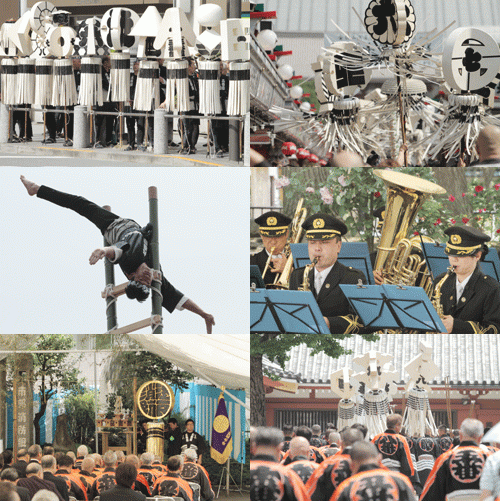 |
||
| June, 2024(Minatsuki) | ||
| 7th-9th | Torigoe's night festival | |
| 29th-30th (planned) |
The Beginning of the Mountaineering Season of Mt.Fuji | |
| This ceremony is held connected with the festival held in the Fuji Sengen Shrine at the foot of Mt.Fuji. People call this ceremony "O Fuji San". |
||
| July, 2024(Fumizuki) | ||
| (to be decided) | Downtown Tanabata Festival |
|
| At Kappa-bashi Shopping Mall | ||
| 6th-8th | The festival Of Morning Glories |
|
| Held in Iriya | ||
| 9th-10th | The Forty-Six Thousand Days,The Chinese Lantern Plants Fair | |
| It is said that the people who visit Kannon on these days can get divine protection equal to the people who visit for forty-six thousand days,in other words,for one hundred twenty-seven years every day without only one day absence. | ||
| 27th | The Fireworks Display Around The Sumida River |
|
This event was suspended for a time and was reopened in the 53rd year of Showa.  |
||
| September, 2024(Nagatsuki) | ||
| (to be decided) | Taito Takigi |
|
| Taito Takigi has been done since 1965. Held in the Sensoji Temple. (In case of rain, in Asakusa public hall) |
||
| 15th(planned) | The Asakusa Samba Carnival |
|
This is the Riodejaneiro Carnival in Japanese style.(A reduced version will be held this year.)  |
||
| 20th | Shoten Festival |
|
| Held in Matsuchiyama Shoten | ||
| (to be decided) | The Memorial Service For dolls | |
| Held in Shimizu Kannondo. | ||
| October, 2024(Kannazuki) | ||
| 18th | The Memorial Service For Chrysanthemums |
|
| 1000 points such as bonsai, major work, and cliff will be exhibited at a special venue in Asakusadera temple. |
||
| 18th | The Anniversary Meeting Of The Appearance Of Asakusa Kannon,The Dance Of Gold Dragon | |
| This event is connected with the tradition that the gold figure of Sei Kannon was pulled up from the Miyato River(the present Sumida River) on March 18 in 628. Held in the Sensoji Temple. |
||
| Mid October to Mid November (planned) |
Asakusa Chrysanthemums exhibition |
|
| 1000 points such as bonsai, major work, and cliff will be exhibited at a special venue in Asakusadera temple. |
||
| November, 2024(Shimotsuki) | ||
| 3rd | The Dance Of White Heron |
|
| This event was started to commemorate the centennial of the Meiji restoration in the 43rd year of Showa. The dancing eight dancers in the costume made in the shape of white heron walk around. |
||
| (to be decided)< | the days of Tori(the day comes every twelve days in the calendar of China) chicken's day |
|
| Once this event was the festival named "the Chicken Festival" for celebrating the good harvest in fall and for offering chickens as a token of their thanks for their deities. The word "Tori" also means a chicken. In the Edo era the meaning of the word "Tori" changed to the meaning of the China calendar and the fairs were opened. |
||
| 23th | The Ichiyo Festival | |
| A great woman writer Ichiyo Higuchi's memorial hall,Ichiyo's Memorial Hall,is opened free to the public and the lecture about literature in the Meiji era and so on are held. | ||
| (to be decided)< | Shoes Festival | |
| Shoe manufacturers of Tamahime Inari Shrine hold a charity event as "Shoes Festival". | ||
| December, 2024(Shiwasu) | ||
| 17th~19th | The Hagoita Fair |
|
| Various Hagoita are available from large for decorative use to children's side. | ||
| Middle December | Hakidaore Market |
|
| This event is canceled. Hanakawado Park |
||
| 31th | The Tolling Of The Bells On New Year's Eve | |
| In Asakusa Temple etc. | ||
Note: The schedule may change for items that are "planned".