
![]() This Web site is the e-magazine for general informations about Asakusa. |
|
Asakusa has always been a modern city and one of the busiest cities in Japan. The newest cultures and customs of those days,for example,movies,operas, revues and so on appeared in Asakusa,and those new things went out of fashon one after another, and other new things appeared.
On the other hand,old cultures of Edo have been protected obstinately in Asakusa.
In these days traditional Japanese cultures are fading away even in the minds of Japanese day by day.
They are all earnest teachers and teach even the beginners kindly. |
The following titles are arranged in the Japanese syllabary.

Kappore
|
|
|
This is the general term for the folk songs or the dances for the accompaniment of shamisen which prevailed among people from the Bunka era to the Meiji era. Poor priests prevailed this entertainments by dancing or singing in the form of Sumiyoshi Odori dance in Edo city. In the Meiji era this was also performed in the vaudeville theater. |
|
|
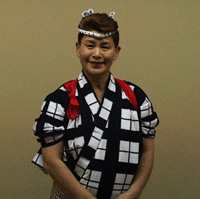
The master Sakuragawa Pinsuke
She is the 2nd master after the 1st Sakuragawa Pinsuke(his father). |

Kouta
|
|
|
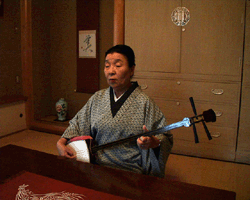
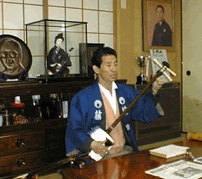
One of the kinds of the music for shamisen. The words for the songs of Kouta are comparatively short and pun,irony and smartness in the words are the essense of the interest of kouta and the high technique is used in the way of singing,for example,to suppress the voice extremely. It contains the elements of the other Japanese musics,for example,nagauta,kiyomoto,tokiwazu and other old musics. So,its taste is profound. It is sung in more rapid tempo than utazawa(famous Japanese music). |
|
|
The master Kasuga Toyoseiyoshi
Born in Asakusa.Belongs to Kasuga group. |
Kokyu
|
|
|
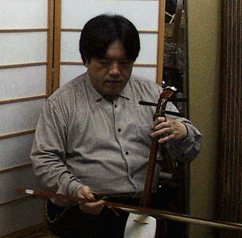
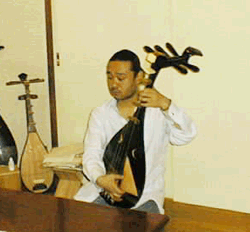
In a wide sense "Kokyu" is a popular name or a general term of string rubbed instruments,and in a narrow sense "Kokyu" is a proper noun for the musical instrument. In the accompaniment for Japanese folk songs or Japanese ballad dramas shamisen,sho and kokyu were once used as the main musical instruments,but in these days they are replaced by shakuhachi. In Kanto district kokyu of 4 strings is usually used and in Kansai district that of 3 strings is used. And,they are quite different musical instruments from "Niko" in China. |
|
|
The master Hara Kazuo
When he was 12 years old,he was fascinated by the sound of kokyu resounding from the radio and started learning.
We hear he has kept company with kokyu for 30 years. |

Koto
|
|
|
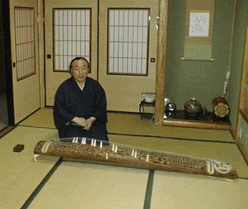
The string instrument of China,Korea and Japan. Koto is the string instrument with 13 strings and small poles put under them and played with the plectrums put on the thumb,the forefinger and the middle finger. This musical instrument was mainly handed down by the blind persons and in these days the Yamada school of round plectrum and the Ikuta school of dice plectrum are popular. There is another style of 17 strings designed in the Taisho era. |
|
|
The master Harada Toryu
He had been trained by his mother since he was 6 and half years old. |

Nagauta
|
|
|
These are the artistic songs accompanied with mainly shamisen. They originate from the accompaniment for "kabuki" dance in the Edo era and were influenced by the folk songs in Kamigata(the present Kansai district) and absorbed lyrical and narative elements from various songs and grew into the shape of today. They were called "Edo Nagauta" in the old times. The members for performance of nagauta are separated into singers and players. |
|
|
The master
Yaichiro Kineya
Master Kineya was born and brought up in Asakusa, Daito-ku in Tokyo. |

Biwa(Satsuma biwa)
|
|
|
The string snapped instrument. This string snapped instrument belongs to one of the kinds of lute. The peach styled body is put two boards on the front and the back and a small pole is put on the curved neck. And,the strings are stretched on it and played by big stick powerfully. Biwa introduced in about the 7th century through West Asia and the Silk Road are roughly classified as gakubiwa,mosobiwa,Heikebiwa,Satsumabiwa and Chikuzenbiwa. |
|
|
The master Tomoyoshi Kakushin
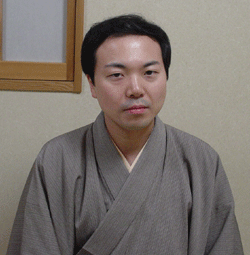
Born in Asakusa Tokyo in 1965.He had learned various kinds of traditional entertainments. |

Minyo
|
|
|
Folk songs handed down from people to people.The style is the songs accompanied with the musical instruments for the accompaniment,shamisen,drums,shakuhachi and so on. And,some of the songs became the public entertainments and the local specialties. |
|
|
The master Fujita Shujiro
He is from Akita prefecture. |

Hayashi
|
|
|
"Hayashi" is unisons and accompaniments which compliment other music or dramas. It is the word of which the verb"hayasu"(means to accompany) changed to the noun"hayashi". It is the music mainly played by percussion instruments and wind instruments. Pipes,kotsuzumis,ohtsuzumis,drums and so on are used. In a wide sense three types of music,the music played by the above instruments,nagauta(songs) and the music played by shamisen should be called "Hogaku hayashi"(Japanese music hayashi). Many of the"hayashi" musics as the folk musics are the sound for the festivals. |
|
|
The master Mochizuki Tazae
Born in Nihonbashi.His mother was born in Asakusa. |

|
|
|
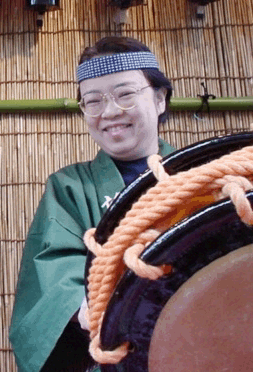
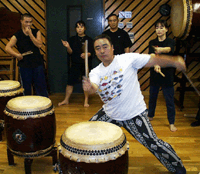
The sound of Japanese Drums can express the spirit of Japanese.And,these musical instruments can move the people. Everyone,regardless of age or sex,can enjoy the sound. The shime daiko drums(the drums tightened by strings),the middle sized drums,the big sized drums,the okedo daiko drums(made of the tub) and the thin portable drums are mainly used. Most of the drumsticks for the middle sized drums are made of evergreen oaks and most of the drumsticks for the big sized drums and the shime daiko drums are made of Japanese cypress or bracts. |
|
|
The master Tosha Kiyonari
He is a holder of diploma of the Tosha School of musical accompaniment for nagauta music. |
Every inquiry and question about traditional entertainments are acceptable.jidaiya@asakusa-e.com